
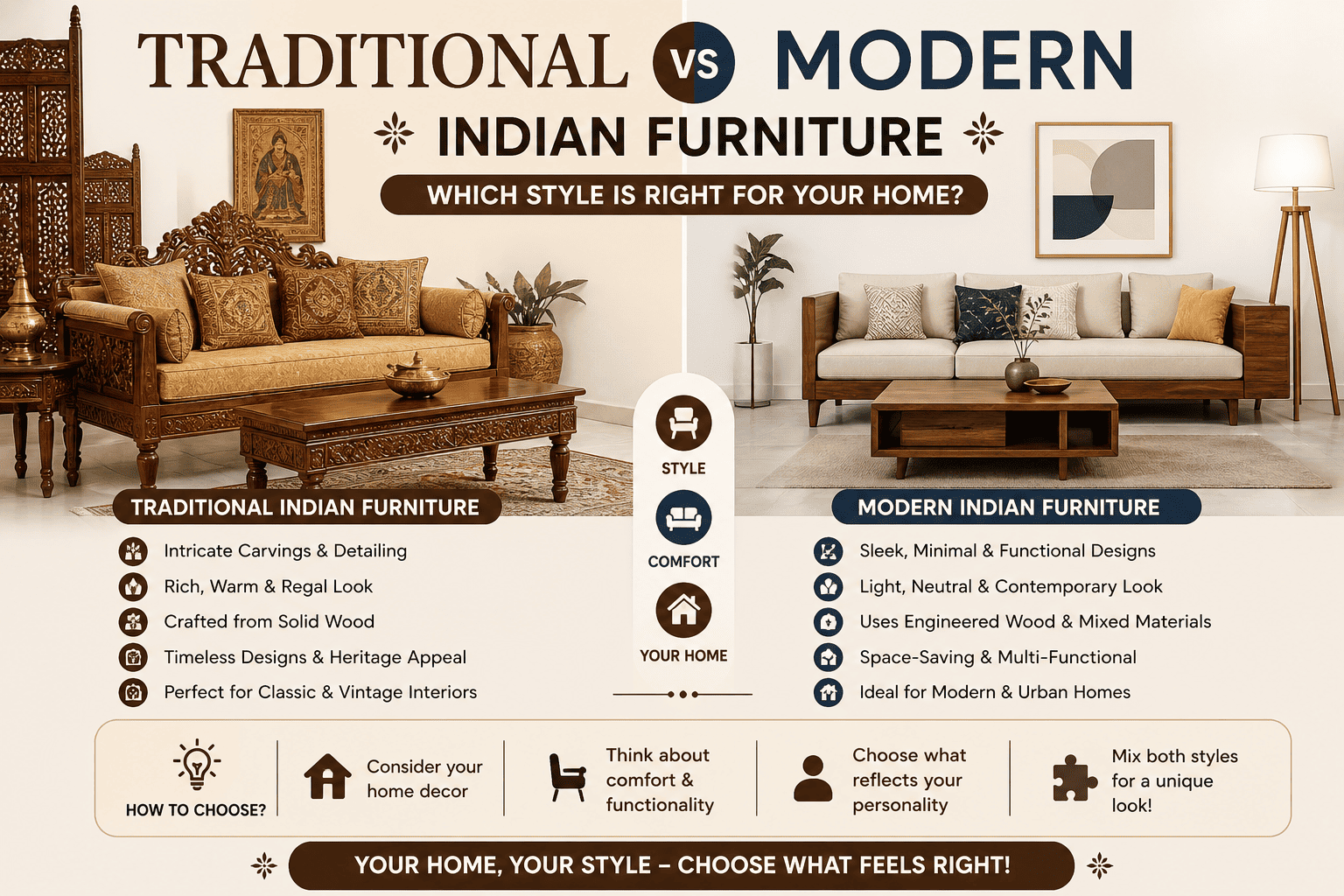
Traditional and modern Indian furniture are not opposites — they are two expressions of the same craft tradition. Both use solid timber, hand-joinery, and artisan workshops. The difference is in the surface — how much carving, how much ornament, how contemporary the proportions. Choosing between them, or mixing both, depends on your home, your taste, and how you want the pieces to sit in an Australian interior.
What Defines Traditional Indian Furniture
Heavy hand: carved detail on frames, legs, arms, and headboards. Motifs drawn from Rajasthani, Mughal, Punjabi, and South Indian carving traditions.
Deep saturated colours in upholstery: burgundy, royal blue, emerald green, and saffron. Often with tufting, fringing, or traditional embroidery.
Gold-leaf, brass, or metal detailing as decorative elements.
Larger scale — Royal sofa sets at 9-seaters, carved beds with tall headboards, and dining sets for 8 or 10.
Ornamental elements like carved domes on mandirs, finials on bed posts, turned feet on furniture.
What Defines Modern Indian Furniture
Clean lines with minimal ornament. Straight edges, rectangular proportions, and focus on materials rather than surface detail.
Neutral or restrained colour palettes. Cream, grey, tan, muted navy.
Modest metal accents — maybe brushed brass handles, slim metal legs, or no metal at all.
Standard contemporary proportions. 3-seater sofas, queen-size beds, 6-seater dining tables.
Emphasis on materials — the timber grain, marble veining, or leather texture speaks for itself.
Solid timber construction and hand joinery are still present but applied to pared-back designs.
Pros and Cons of Traditional
Pros: distinctive character, cultural authenticity, makes a statement, ages beautifully with carved wood developing patina, and holds cultural and collector value.
Cons: can feel dominant in a small room, requires deliberate styling to avoid looking dated, more challenging to coordinate with non-Indian decor.
Best for: larger homes with room for statement pieces, Indian and Punjabi families wanting pieces that reflect heritage strongly, formal spaces (living room, dining room, pooja room), dedicated cultural pieces (mandirs, jhulas).
Pros and Cons of Modern
Pros: works in any home regardless of size, coordinates with contemporary decor easily, feels timeless, less challenging to style, broader resale appeal.
Cons: less immediately distinctive, some pieces can look similar to mainstream modern furniture, cultural authenticity is more subtle.
Best for: smaller homes and apartments, casual family spaces, bedrooms and offices, homes with mixed decor styles, younger buyers leaning contemporary.
Mixing the Two
The most interesting Indian homes in Australia mix traditional and modern deliberately.
Formal living room: traditional carved sofa set, modern lighting, neutral rug.
Family room: modern sectional sofa, traditional coffee table as the centrepiece.
Dining room: traditional carved 8-seater, modern pendant lighting.
Bedrooms: modern upholstered beds with traditional side tables or dressing tables.
Pooja room: fully traditional — mandir, carved shelving, cultural pieces.
This mix-and-match approach takes advantage of both styles while avoiding the downsides of either alone.
How to Decide
Consider your home first: Heritage and larger builds suit traditional. Modern apartments and contemporary builds suit modern or mixed.
Consider your lifestyle: Formal entertaining favours traditional. Casual family life favours modern.
Consider your taste: If you love rich detail, go traditional. If you love clean lines, go modern. Both are valid.
Consider longevity: Traditional Indian furniture ages particularly well — the carving and solid wood become more beautiful over decades. Modern pieces age well too, but the aesthetic appeal is more tied to current taste.
The Craft Is the Same
Whatever you choose, the craftsmanship underneath should be the same. Solid timber frames. Hand-joinery. Real materials. If you buy traditional or modern Indian furniture from a specialist, you are buying the same underlying quality — just with different surface expressions.
Conclusion
Traditional Indian furniture suits homes wanting distinctive character and cultural depth. Modern Indian furniture suits homes wanting craftsmanship with contemporary aesthetics. Mixing the two — traditional in formal spaces, modern in casual — often gives the best result.
| Browse both the Royal Collection and our modern pieces, visit the showroom, or call 0404 000 536. |
FAQs
Q1: What is the main difference between traditional and modern Indian furniture?
A: Traditional features heavy hand-carved detail, deep colours, tufted upholstery, and gold detailing. Modern retains craftsmanship — solid wood, hand-joinery — but with cleaner lines, less surface ornament, and contemporary proportions.
Q2: Can I mix traditional and modern Indian pieces in the same home?
A: Yes. A common approach is traditional pieces in formal spaces (living room, dining room, pooja area) and modern pieces in casual spaces (family room, bedrooms). Both styles share the same craftsmanship so they coordinate naturally.
Q3: Which style holds value better over time?
A: Both, when construction is solid wood and joinery is genuine. Traditional pieces hold cultural and collector value. Modern pieces hold design value and tend to feel more timeless to broader audiences.